DAYamlChecker: static analysis and linting
dayamlchecker is a static analysis tool for Docassemble packages. It reads interview
YAML, embedded Python and Mako, Python test modules, and Word (.docx) templates, and
reports broken interview logic, syntax errors, broken URLs, style problems, and Web
Content Accessibility Guidelines (WCAG) failures.
Installation
dayamlchecker requires Python 3.12 or later.
# With pip
pip install dayamlchecker

# Or as a standalone tool with uv
uv tool install dayamlchecker
To work on dayamlchecker itself:
git clone https://github.com/SuffolkLITLab/DAYamlChecker.git
cd DAYamlChecker
pip install -e .
Installing provides two commands, dayamlchecker and dayamlchecker-fmt (a formatter
for interview YAML). The examples below use python3 -m dayamlchecker, which is
equivalent to running dayamlchecker and works even when the script directory is not on
your PATH.
Running DAYamlChecker
Pass files or directories. Directories are searched recursively, skipping .git*,
.github*, build, dist, node_modules, and sources unless you pass --check-all.
# One interview
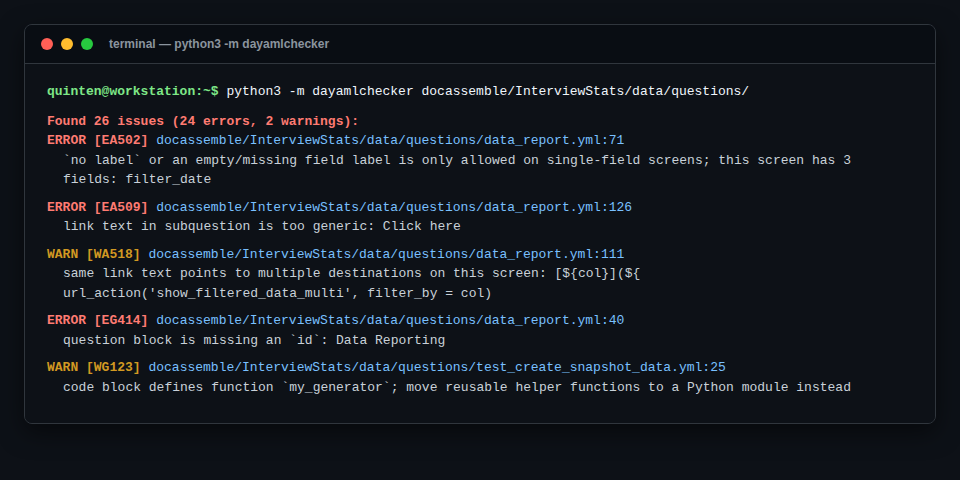
python3 -m dayamlchecker docassemble/MyPackage/data/questions/interview.yml

# Every interview in a package
python3 -m dayamlchecker docassemble/MyPackage/data/questions/

# Word templates
python3 -m dayamlchecker docassemble/MyPackage/data/templates/

# Both at once
python3 -m dayamlchecker docassemble/MyPackage/data/
What DAYamlChecker checks
Findings belong to one of four classes: general, accessibility, style, and
translatability. Each finding has a code whose first letter is its severity (E error,
W warning, I info) and whose second letter is its class (G, A, S, T).
1. YAML structure and Docassemble integrity (general)
| Check area | Description | Example codes |
|---|---|---|
| YAML syntax | Unclosed quotes, indentation mistakes, invalid characters | EG102 (YAML parse error) |
| Duplicate keys | A key repeated inside one block | EG101 |
| Duplicate block ids | An id: reused across blocks, where Docassemble silently keeps the last one | EG104 |
| Docassemble keys | Unrecognized keys in a block | EG301 |
| Question ids | A question block with no id: | EG414 |
| Mandatory logic | More than one unconditioned mandatory: True block | WG415 |
| Field definitions | Empty fields:, fields that collect no input, empty variable targets | EG418, EG420, EG421 |
| Test modules | A Python test module that does not start with # do not pre-load, which makes Docassemble import it during server startup | EG105 |
2. Embedded Python, Mako, and JavaScript (general)
- Python code blocks: syntax errors (
EG122), and a warning when a code block defines a function that belongs in a Python module instead (WG123). - Mako:
${ ... }expressions and% if ...control lines inside questions, subquestions, and field values (EG111,EG112), plus malformed Markdown links in Mako-rendered text (WG113). - JavaScript:
datatype: jsexpressions, including.val()calls and references to fields that are not on the screen (EG204–EG207).
3. WCAG and web accessibility (accessibility)
Accessibility checks run by default. Disable them with --no-wcag.
- Heading structure: skipped Markdown heading levels such as
##to####(EA506), and the same in HTML (EA507). - Alt text: Markdown images (
EA505), HTML<img>tags, and Docassemble[FILE ...]tags. Write[FILE logo.png, alt="Suffolk LIT Lab logo"]. - Link text: empty links (
EA508), non-descriptive text such as "click here", "here", "read more", and Spanish equivalents like "haga clic aquí" (EA509), the same link text pointing at different destinations (WA518), and links that open a new tab without telling the user (WA519). - Field labels:
no labeland empty labels on screens with two or more fields (EA502), non-descriptive labels (WA512), and duplicate labels on one screen (WA515). - Comboboxes: off by default while the rule is evaluated. Turn it on with
--accessibility-error-on-widget combobox(EA501). - Custom theme contrast: when a theme is loaded with
features: bootstrap theme:, the CSS is parsed and body text, navbar links, dropdown items, and buttons are checked against a 4.5:1 minimum ratio (EA504). - Display templates: templates shown with
display_template()need asubject(WA529). - PDF tagging: an informational note when an attachment does not set
tagged pdf: True(IA503).
WCAG checks still report YAML parse errors, so one run surfaces both broken YAML and accessibility failures. This is source analysis: it cannot see problems that only appear in a rendered page or in JavaScript at runtime.
4. DOCX template accessibility (accessibility)
Any .docx file you pass is opened and its OpenXML structure inspected. These checks run
by default; --no-docx-accessibility skips them.
- Alt text: images (
WA541), shapes and other objects (WA542), placeholder alt text (WA548), and alt text on images marked decorative (WA547). - Links: empty link text (
WA543), a raw URL used as link text (WA549), and ambiguous link text (WA550). - Document metadata: missing document language (
WA545) and missing document title (IA561). - Headings: documents with no headings (
WA556), empty headings (WA555), a first heading below level 1 (WA557), and skipped levels (WA558). - Tables: no header row marker (
WA552), merged cells (WA546), and tables that look like they are being used for layout (WA551). - Reading order: floating objects (
WA553) and text boxes (WA554) that pull text out of the main flow. - Spacing: long runs of empty paragraphs used instead of paragraph spacing
(
IA565) and manually typed list numbering (IA566).
Because a DOCX has no line numbers, each finding names the package part it came from
(word/document.xml, word/header1.xml) and quotes up to 80 characters of nearby text
so you can search for it in Word:
WARN  [WA552] docassemble/MyPackage/data/templates/discovery.docx
  a table in word/document.xml has no obvious header row marker
  (table begins "Certificate of Service")
Every DOCX finding is capped at warning severity, so turning these checks on reports
problems without failing a build. Most existing templates have findings today, and the
intent is for authors to work through them over time. Pass
--docx-accessibility-severity error to restore each rule's own severity and fail on
errors.
Why DOCX is checked here and PDF is checked with veraPDF
dayamlchecker checks DOCX templates directly, while PDF templates are validated by
veraPDF inside the da_build action. A DOCX is a zip
of XML that pure Python can read, so the check is fast and runs anywhere. Validating
PDF/UA-1 means implementing a large ISO specification, and veraPDF is the reference
implementation — but it is a Java application, and bundling a JRE into a Python linter
would be a heavy price for local use. So da_build installs veraPDF in CI, where a Java
runtime is already available.
5. Broken URLs
Absolute HTTP and HTTPS links in interview files, and in the data/templates files
those interviews sit alongside, are requested concurrently. A broken link in a question
file is an error; a broken link in a template is a warning by default.
# URL checking is on by default
python3 -m dayamlchecker docassemble/MyPackage/data/questions/

# Skip endpoints that block CI or are known to be flaky
python3 -m dayamlchecker --url-check-ignore-urls "https://flaky-court.gov,https://status.example.org" docassemble/MyPackage/data/questions/

# Turn it off, for example when working offline
python3 -m dayamlchecker --no-url-check docassemble/MyPackage/data/questions/
6. Style and translatability (style, translatability)
Assembly Line style checks are opt in.
# Deterministic style and translatability rules
python3 -m dayamlchecker --style docassemble/MyPackage/data/questions/

# Add rules backed by an OpenAI-compatible model
OPENAI_API_KEY="sk-..." python3 -m dayamlchecker --style-llm docassemble/MyPackage/data/questions/
--style-llm implies --style, and reads OPENAI_BASE_URL, OPENAI_API_KEY, and
OPENAI_MODEL from the environment when the matching flags are not given.
Style rules cover plain language, screen titles, overlong labels, too many fields on one
screen, review screens, and inclusive gender and pronoun fields. They also include the
rule that # and <h1> belong to the question itself and should not appear in a
subquestion (ES701).
Translatability rules use WT codes: choice lists whose labels are translated but whose
stored values are not invariant (WT701), user-facing strings written inside Python code
(WT702), and conditional expressions or Mako blocks that change only part of a sentence
and so cannot be translated as a unit (WT703, WT704).
Fixing findings automatically
Four of the rules above describe a change with only one sensible answer: a question block
with no id:, a yes/no shorthand, a duplicate block id, and an unlabeled field on a
multi-field screen. Pass --fix and dayamlchecker rewrites those in place, then runs
the normal check and reports whatever is left.
python3 -m dayamlchecker --fix docassemble/MyPackage/data/questions/
| Code | What it changes |
|---|---|
EG414 | Adds id: to a question block, derived from the question text |
EG104 | Suffixes later duplicate block ids (review answers, review answers 2) |
EA510 | Expands a yesno: / noyes: shorthand into fields: with an explicit datatype: |
EA502 | Labels the first unlabeled field on a multi-field screen with the question text |
Given this interview:
---
question: |
  Do you agree to the terms?
yesno: user_agrees
---
question: |
  Tell us about your income
fields:
  - no label: income_amount
    datatype: currency
  - Employer: employer_name
---
id: review answers
question: Review your answers
---
id: review answers
question: Review them again
--fix reports what it changed and then re-checks the result:
Fix mode: scanned 1 YAML files; wrote changes in 1; skipped 0; rejected 0.
Fixes by rule: {'EA502': 1, 'EA510': 1, 'EG104': 1, 'EG414': 2}
No issues found.
---
id: "do you agree to the terms"
question: |
  Do you agree to the terms?
fields:
  - no label: user_agrees
    datatype: yesnoradio
---
id: "tell us about your income"
question: |
  Tell us about your income
fields:
  - "Tell us about your income": income_amount
    datatype: currency
  - Employer: employer_name
---
id: review answers
question: Review your answers
---
id: "review answers 2"
question: Review them again
What the fixes actually do
Generated ids are the question text reduced to lowercase letters, digits and spaces.
Punctuation and Mako delimiters become word separators, so ${city_only_address} becomes
city only address, while apostrophes are dropped rather than split on, so didn't
becomes didnt. Two questions that differ only in punctuation or case therefore collide,
and the second is suffixed. Ids you wrote yourself are never rewritten; a duplicate one
only gains a suffix.
Yes/no shorthands keep their meaning: yesno: and noyes: become
datatype: yesnoradio, and yesnomaybe: / noyesmaybe: become datatype: yesnomaybe.
This changes what the applicant sees — a screen that was two buttons becomes a radio
group with a Continue button — so it is worth loading one converted screen before you
merge a large batch.
Field labels are the screen's question text, and only the first unlabeled field on
a screen is labeled. The question can only sensibly describe one field, so the rest are
left reported for you to write by hand. That also makes the fix stable: running --fix
again will not start consuming the fields left for review.
When the question text uses Mako line directives, the label moves to the long form,
because % if only works at the start of a line and cannot survive being folded into a
one-line label:
fields:
  - label: |
      % if filled_by_attorney:
      Does ${ users[0] } want to be the guardian?
      % else:
      Do you want to be the guardian?
      % endif
    field: wants_guardianship
    datatype: yesnoradio
Inline ${ ... } expressions evaluate fine mid-line and keep the shorter form.
What it will not do
Every edit is checked before it is written. A file is rewritten only when the result still parses, introduces no new finding of any rule, and actually removes the finding the edit was made for. A file that fails any of those is left untouched and reported on standard error:
Fix skipped docassemble/MyPackage/data/questions/intake.yml: could not safely rewrite id near line 6
Fix rejected docassemble/MyPackage/data/questions/income.yml: candidate introduces new findings: WA515 (0 -> 1)
That second one is the interesting case: labeling a field with the question text would have produced two fields sharing a label on the same screen, so the edit was thrown away rather than trading one finding for another.
A file the fixer cannot rewrite is a limit of the fixer, not a problem in your interview, so it does not by itself fail the run — only real findings affect the exit code.
--fix respects the flags that turn rules off--fix never rewrites source for a rule the same run would not report. With --no-wcag
it leaves EA510 and EA502 alone, and --suppress EG414 means no ids are generated.
# no-dayc: comments are honored the same way. This also means --suppress ALL disables
fixing entirely, which is worth remembering if you use it to quiet the output.
Previewing before you write
--fix writes immediately. To see the plan first, run the fixer directly — its default
mode is a dry run, and --report writes the summary as JSON:
# Show what would change, without touching anything
python3 -m dayamlchecker.fixer docassemble/MyPackage/data/questions/

# Same, saved as JSON
python3 -m dayamlchecker.fixer --report fixes.json docassemble/MyPackage/data/questions/

# Write the changes
python3 -m dayamlchecker.fixer --write docassemble/MyPackage/data/questions/
Mode: dry-run
YAML files scanned: 1
Files with changes: 1
Files skipped: 0
Files rejected by validation: 0
Changes by rule: {'EA502': 1, 'EA510': 1, 'EG104': 1, 'EG414': 2}
The fixes preserve your formatting and touch only the lines they need to, but they are
still automated edits across every file you point at. Commit or stash your work first, so
git diff shows you exactly what the fixer did.
Suppressing findings
Suppress by code (EA509) or by finding class (accessibility, style,
translatability, general). ALL or * suppresses everything at that location.
On one line
subquestion: |
  Please [click here](https://example.com) for details.  # no-dayc: EA509
For a whole block
Put # no-dayc-block: anywhere inside the block, usually just after the --- separator:
---
# no-dayc-block: accessibility, EG301
question: Custom widget
fields:
  - no label: custom_widget_data
For a whole run
python3 -m dayamlchecker --suppress accessibility,EG101 docassemble/MyPackage/
# no-dayc: and # no-dayc-block: comments live in YAML, and a Word document has
nowhere to put them. Silence a noisy DOCX rule with --suppress instead, for example
--suppress IA561 for the missing document title.
Command line reference
| Flag | Description | Default |
|---|---|---|
files | One or more YAML, Python, or DOCX files or directories | Required |
--suppress CODE | Suppress a code or finding class; repeatable and comma-separated | none |
--check-all | Search ignored directories too (.git*, .github*, build, dist, node_modules, sources) | off |
--fix | Apply the four deterministic fixes in place, then check the result | off |
--no-wcag | Turn off WCAG accessibility checks | WCAG on |
--accessibility-error-on-widget WIDGET | Treat a widget, such as combobox, as an error | none |
--style | Turn on Assembly Line style and translatability rules | off |
--style-llm | Add LLM-backed style rules; implies --style | off |
--openai-base-url URL | Base URL for an OpenAI-compatible API | OPENAI_BASE_URL |
--openai-api-key KEY | API key for --style-llm | OPENAI_API_KEY |
--openai-model MODEL | Model name for --style-llm | OPENAI_MODEL, else gpt-4o-mini |
--url-check / --no-url-check | Check that URLs resolve | on |
--url-check-timeout SECONDS | Per-request HTTP timeout | 10 |
--url-check-root PATH | Repository root used to find related template files | inferred |
--url-check-ignore-urls URLS | Comma- or newline-separated URLs to skip | none |
--url-check-skip-templates | Do not check URLs inside data/templates files | off |
--template-url-severity CHOICE | Severity for broken template URLs: error, warning, ignore | warning |
--unreachable-url-severity CHOICE | Severity for URLs that could not be reached at all | warning |
--docx-accessibility / --no-docx-accessibility | Check DOCX templates | on |
--docx-accessibility-severity CHOICE | Severity cap for DOCX findings: warning or error | warning |
--format CHOICE | text, or github for GitHub Actions annotations | text |
--max-warnings N | Fail if more than N warnings are reported | no limit |
Python API
from dayamlchecker import (
    RuntimeOptions,
    find_errors_from_string,
    find_style_findings_from_string,
)

yaml_code = """
id: user_income
question: What is your income?
fields:
  - Income: user_income
    datatype: currency
"""

for finding in find_errors_from_string(yaml_code, input_file="interview.yml"):
    print(f"[{finding.code}] {finding.message} (line {finding.line_number})")

style_findings = find_style_findings_from_string(
    yaml_code,
    input_file="interview.yml",
    runtime_options=RuntimeOptions(style_enabled=True),
)