Assembly Line GitHub Actions (ALActions)
SuffolkLITLab/ALActions holds the reusable GitHub Actions the Document Assembly Line uses for Docassemble packages: package builds, YAML and template checking, readable Word diffs, PDF accessibility validation with veraPDF, Python linting and tests, playground deployments, and uptime monitoring.
All of them are composite
actions.
Reference them at @main so that fixes reach your repositories without a version bump:
- uses: SuffolkLITLab/ALActions/da_build@main
Action catalog
| Action | What it does | Typical triggers | What it produces |
|---|---|---|---|
da_build | Package build, Python compile, YAML checks, DOCX and PDF accessibility, URL checks | push, pull_request | Inline annotations, a PDF accessibility step summary |
valid_jinja2 | Compiles Jinja2 expressions in changed .docx templates | push, pull_request on .docx paths | Step summary table, jinja-validation artifact |
word_diff | Converts changed .docx templates to Markdown and HTML diffs | pull_request, workflow_dispatch | Diffs in the step summary, word-doc-diff artifact |
black-formatting | Runs Black over the repository | push, pull_request | A failing job when files need reformatting |
docsig | Checks Google-style docstrings against signatures | push, pull_request | Docstring mismatches in the job log |
pythontests | Mypy, Bandit, and pytest | push, pull_request | Type, security, and test output |
da_playground_install | Installs the branch into a playground project | push on feature branches | A live interview to click through |
da_package | Installs the package server-wide | push on main or a tag | A deployed package |
hall_monitor | Checks that installed interviews still load | schedule | Email or Teams alerts on failure |
da_build: build and check the package
da_build is the main check for a Docassemble package. It runs, in order:
- Python compile:
python -m compileall ., so no Python file has a syntax error. - Package build:
uv build, producing a wheel and an sdist indist/. - YAML and DOCX checks:
dayamlcheckerover the package's interview files and Word templates, reporting findings as GitHub annotations. - URL checks: every absolute URL in question and template files is requested. A broken link in a question file fails the job; one in a template is a warning.
- PDF accessibility: veraPDF is installed and every PDF template is validated against PDF/UA-1 (ISO 14289-1).
Sample workflow
Create .github/workflows/build_and_check.yml. da_build checks out the repository
itself, so you do not need an actions/checkout step:
name: Build and check package

on:
  push:
    branches: [main]
  pull_request:
    branches: [main]
  workflow_dispatch:

jobs:
  build-and-validate:
    runs-on: ubuntu-latest
    steps:
      - uses: SuffolkLITLab/ALActions/da_build@main
        with:
          python-version: "3.12"
          # Optional: skip endpoints that block CI or are known to be flaky
          ignore-urls: |
            https://example.com/known-flaky-endpoint
            https://another.example.org/blocked-from-ci
Inputs
| Input | Description | Default |
|---|---|---|
python-version | Python version used for the build environment | "3.12" |
skip-url-check | "true" skips all URL network calls | "false" |
skip-templates | "true" skips URLs found inside data/templates files | "false" |
ignore-urls | Comma- or newline-separated URLs to ignore during URL checks | "" |
docx-validation-mode | "warning" annotates without failing, "error" fails on DOCX accessibility errors, "off" skips DOCX checks | "warning" |
pdf-validation-mode | "warning" annotates without failing, "error" fails on PDF/UA-1 failures, "off" skips the check and the veraPDF install | "warning" |
pdf-strict | "true" also enforces tab-order and annotation-structure rules on form fields | "false" |
Which files are checked
da_build does not check every file in the repository. It matches:
docassemble/*/data/questions/**/*.ymlfor interview checks, so that workflow files and ALKiln fixtures are not mistaken for interviews, anddocassemble/*/data/templates/**/*.docxfor document accessibility, so that only the documents users actually receive are checked. Word lock files (~$…) are skipped.
build/, dist/, and .venv/ are pruned, because the uv build step above has already
copied the package into build/lib. Without pruning, every finding would be reported
twice and the annotations would point at the copy rather than at the file you edit.
Note that templates are found by scanning the directory, not by following references from a YAML file. A template that no interview mentions yet is still checked.
Adjusting what fails the build
- DOCX accessibility is reported as warnings by default, because most existing
templates have findings and the intent is to work through them over time. Set
docx-validation-mode: "error"once a package is clean, or"off"to skip it. - PDF accessibility is likewise
"warning"by default. Setpdf-validation-mode: "error"to block merges on PDF/UA-1 failures. Leavepdf-strictat"false"unless your forms stay fillable for the user: tab-order and annotation rules are suppressed by default because Assembly Line forms are usually flattened before anyone sees them. - URLs: set
skip-templates: "true"to ignore links insidedata/templates, orskip-url-check: "true"to make no network calls at all, which is what you want on a runner without outbound internet access. - Individual findings: suppress them in the YAML itself with
# no-dayc:and# no-dayc-block:comments. DOCX findings have no YAML to annotate, so a noisy document rule has to be silenced with--suppresswhen runningdayamlcheckerlocally, or turned off for the whole job withdocx-validation-mode.
dayamlchecker checks URLs as part of its own run, and da_build then runs the URL
checker again as a separate step so that warnings can be surfaced as a job annotation.
Seeing the same link reported in two steps is expected.
To audit templates locally at full strictness before pushing:
python3 -m dayamlchecker --docx-accessibility-severity error docassemble/MyPackage/data/templates/
valid_jinja2: check Jinja2 in Word templates
Docassemble builds Word documents with docxtpl, which is Jinja2. A typo like
{{ user.firs_name }} or an unclosed {% if %} only fails when a user tries to download
the document. valid_jinja2 compiles the templates in a pull request instead.
- Syntax errors fail the job.
- Unknown filters are warnings, not failures. The action knows 124 Jinja2 and
Docassemble filters, including
currency,format_date,title_case,nice_number,ordinal,word, andcomma_and_list. - Added and modified
.docxfiles are found withgit diffagainst the pull request base. Only committed changes are compared, so commit a fixed template before expecting the result to change. - A Markdown summary is always written to the step summary. The HTML artifact is uploaded only when there is something to report.
Sample workflow
name: Validate DOCX templates

on:
  pull_request:
    paths: ['**/*.docx']
  push:
    paths: ['**/*.docx']
  workflow_dispatch:

jobs:
  validate-templates:
    runs-on: ubuntu-latest
    steps:
      - uses: SuffolkLITLab/ALActions/valid_jinja2@main
Inputs
| Input | Description | Default |
|---|---|---|
base_ref | Git ref to compare against | detected from the event |
working_directory | Directory to run from | . |
artifact_name | Name of the uploaded artifact | jinja-validation |
output_dir | Directory for the HTML reports | jinja_validation |
summary_file | Path for the Markdown summary | jinja_validation_summary.md |
skip_checkout | "true" if the job already checked out the repository with fetch-depth: 0 | "false" |
word_diff: readable diffs for Word templates
GitHub shows a changed .docx as a replaced binary file, which tells a reviewer nothing.
word_diff converts both versions to Markdown and diffs the text.
It is not a pass/fail check. On any pull request that touches a Word document it produces
a report, whether or not anything is wrong; when no .docx changed between the two
commits it says so in the summary and stops.
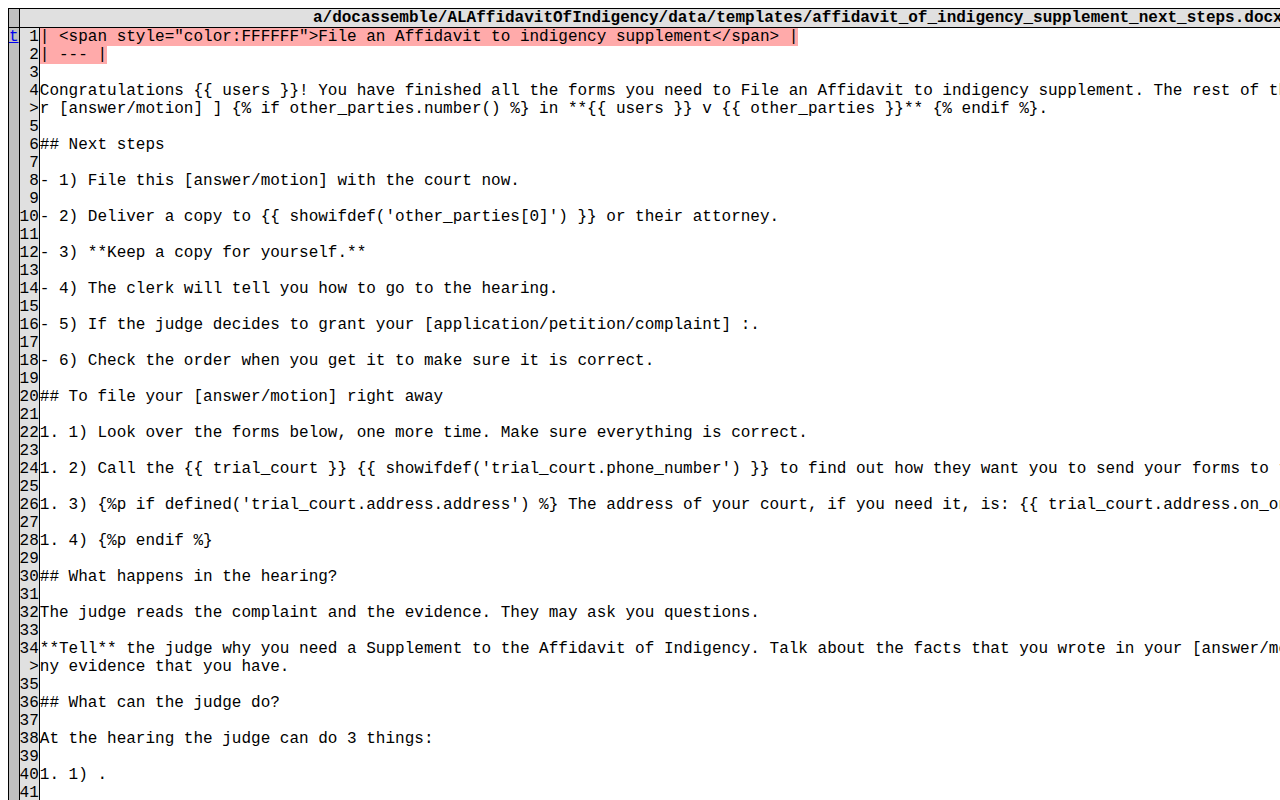
- In the step summary: a unified diff per changed file, so a reviewer can read the change without downloading anything.
- In the artifact: side-by-side HTML diffs plus the converted Markdown, with an
index.htmltable of contents. - Jinja2 is preserved, so a change from
{{ user.name }}to{{ users[0].name }}shows up as a text change like any other.
Sample workflow
name: Diff Word documents

on:
  pull_request:
    paths: ['**/*.docx']
  workflow_dispatch:

jobs:
  docx-diff:
    runs-on: ubuntu-latest
    steps:
      - uses: SuffolkLITLab/ALActions/word_diff@main
Inputs
| Input | Description | Default |
|---|---|---|
base_ref | Git ref or SHA to compare against | detected from the event |
working_directory | Directory to run from | . |
artifact_name | Name of the uploaded artifact | word-doc-diff |
output_dir | Directory for the diff files and index.html | word_diffs |
summary_file | Path for the Markdown summary | word_diff_summary.md |
skip_checkout | "true" if the job already checked out the repository with fetch-depth: 0 | "false" |
For a manually dispatched run, pass base_ref explicitly; the automatic detection only
covers pull requests and pushes.
black-formatting: Python formatting
Runs Black over the repository, excluding
__init__.py and setup.py. The job fails if any file would be reformatted.
jobs:
  lint-python:
    runs-on: ubuntu-latest
    steps:
      - uses: SuffolkLITLab/ALActions/black-formatting@main
Black also reads pyproject.toml. Most Assembly Line packages include:
[tool.black]
extend-exclude = '(__init__.py|setup.py)'
black-formatting and pythontests both declare an output (linting-passed and
tests-passed). Neither is currently populated with a meaningful value. Depend on
whether the job succeeded instead.
docsig: docstrings that match their signatures
docsig checks that every documented parameter exists, that every parameter is
documented, and that the style is consistent. Assembly Line packages use Google-style
docstrings.
jobs:
  docstrings:
    runs-on: ubuntu-latest
    steps:
      - uses: SuffolkLITLab/ALActions/docsig@main
The action checks every .py file except test*.py, setup.py, and __init__.py, and
disables the description-not-capitalized rule. Configure the rest through
[tool.docsig] in pyproject.toml; see the
docsig README.
pythontests: types, security, and tests
- Installs the system libraries Docassemble packages tend to need, and sets
ISUNITTEST=true. - Installs dependencies with
uv sync --group devwhenpyproject.tomlhas a[dependency-groups]table, anduv syncotherwise. - Runs
mypy . --exclude '^build/' --explicit-package-bases. - Runs Bandit at high severity:
uv tool run bandit -r . --exclude './scripts,./venv,./.venv,./build' --severity-level=high. - Runs
pytest.
jobs:
  test-python:
    runs-on: ubuntu-latest
    steps:
      - uses: SuffolkLITLab/ALActions/pythontests@main
Configure each tool through pyproject.toml: [tool.pytest.ini_options], [tool.mypy],
and [tool.bandit].
da_playground_install: deploy to a playground
Installs the current branch into a project in a developer's Docassemble playground, so a reviewer can click through the interview. This action installs whatever is in the working directory, so the job must check out the repository first.
name: Deploy to playground

on:
  push:
    branches: ['feature/**']

jobs:
  deploy-playground:
    runs-on: ubuntu-latest
    steps:
      - uses: actions/checkout@v4

      - uses: SuffolkLITLab/ALActions/da_playground_install@main
        with:
          SERVER_URL: ${{ secrets.SERVER_URL }}
          DOCASSEMBLE_DEVELOPER_API_KEY: ${{ secrets.DOCASSEMBLE_DEVELOPER_API_KEY }}
          PROJECT_NAME: "review-${{ github.ref_name }}"
| Input | Description | Default | Required |
|---|---|---|---|
SERVER_URL | Server URL, without a trailing slash, such as https://apps-dev.example.org | none | Yes |
DOCASSEMBLE_DEVELOPER_API_KEY | API key for an account that may install packages | none | Yes |
PROJECT_NAME | Playground project to install into | none | Yes |
USER_ID | Numeric user id | the account the API key belongs to | No |
RESTART | Set to 0 to skip the server restart | restart | No |
da_package: install server-wide
Installs the package for every user on a server. It picks its source in this order:
PYPI_PACKAGE, if set.GITHUB_URL(withGITHUB_BRANCH, defaulting to the repository's default branch), if set. This is usually what you want, because the server can then be updated later with its own update button.- Otherwise, a zip of the working directory — which means the job must run
actions/checkoutfirst.
name: Deploy package server-wide

on:
  push:
    branches: [main]

jobs:
  deploy-package:
    runs-on: ubuntu-latest
    steps:
      - uses: SuffolkLITLab/ALActions/da_package@main
        with:
          SERVER_URL: ${{ secrets.PROD_SERVER_URL }}
          DOCASSEMBLE_DEVELOPER_API_KEY: ${{ secrets.DOCASSEMBLE_DEVELOPER_API_KEY }}
          GITHUB_URL: "https://github.com/${{ github.repository }}"
          GITHUB_BRANCH: "main"
| Input | Description | Default | Required |
|---|---|---|---|
SERVER_URL | Server URL, without a trailing slash | none | Yes |
DOCASSEMBLE_DEVELOPER_API_KEY | API key for an account that may install packages server-wide | none | Yes |
GITHUB_URL | GitHub URL of the package to install | none | No |
GITHUB_BRANCH | Branch to install from | the repository's default branch | No |
PYPI_PACKAGE | PyPI package name to install instead | none | No |
hall_monitor: scheduled checks on a live server
Docassemble's /list page marks any installed interview that failed to load.
hall_monitor fetches that page on a schedule and fails the job if any interview is
marked broken — like a hall monitor looking through doorways, without going in. Set
CHECK_TYPE: "homepage" to check only that / responds.
When the check fails, the action sends alerts through SendGrid, Mailgun, or a Microsoft Teams webhook. This is separate from GitHub's own notifications, which cannot email people who are not watching the repository.
name: Hall monitor

on:
  schedule:
    # 07:00 and 19:00 UTC
    - cron: "0 7,19 * * *"
  workflow_dispatch:

jobs:
  monitor-server:
    runs-on: ubuntu-latest
    steps:
      - uses: SuffolkLITLab/ALActions/hall_monitor@main
        with:
          SERVER_URL: "https://apps.example.org"
          SENDGRID_API_KEY: ${{ secrets.SENDGRID_API_KEY }}
          ERROR_EMAIL_FROM: "Monitor <alerts@example.org>"
          ERROR_EMAILS: "dev-team@example.org,admin@example.org"
| Input | Description | Default | Required |
|---|---|---|---|
SERVER_URL | Server to check, with or without a trailing slash | none | Yes |
CHECK_TYPE | "homepage" to check only /; anything else checks /list | check /list | No |
SENDGRID_API_KEY | SendGrid key for failure emails | none | No |
MAILGUN_API_KEY | Mailgun key for failure emails | none | No |
MAILGUN_DOMAIN | Mailgun sending domain | none | No |
ERROR_EMAIL_FROM | Address the alert is sent from | none | No |
ERROR_EMAILS | Comma-separated recipients | none | No |
TEAMS_MONITOR_WEBHOOK | Microsoft Teams incoming webhook | none | No |
A complete workflow
.github/workflows/quality_checks.yml, combining the checks that run on every change.
da_build, valid_jinja2, and word_diff each check out the repository themselves.
name: Quality checks

on:
  push:
    branches: [main]
  pull_request:
    branches: [main]
  workflow_dispatch:

jobs:
  package-build-and-lint:
    runs-on: ubuntu-latest
    steps:
      - uses: SuffolkLITLab/ALActions/da_build@main
        with:
          python-version: "3.12"

  validate-docx-templates:
    runs-on: ubuntu-latest
    steps:
      - uses: SuffolkLITLab/ALActions/valid_jinja2@main

  diff-word-documents:
    if: github.event_name == 'pull_request'
    runs-on: ubuntu-latest
    steps:
      - uses: SuffolkLITLab/ALActions/word_diff@main

  python-quality:
    runs-on: ubuntu-latest
    steps:
      - uses: SuffolkLITLab/ALActions/black-formatting@main
      - uses: SuffolkLITLab/ALActions/docsig@main
      - uses: SuffolkLITLab/ALActions/pythontests@main