Question library and managing people
The AssemblyLine framework uses standardized object structures (ALPeopleList and ALIndividual) to represent individuals and parties, such as users, other_parties, children, and attorneys.
The Weaver includes a built-in Question library browser that lets you declare people lists and insert pre-built, accessibility-vetted questions directly into your interview.
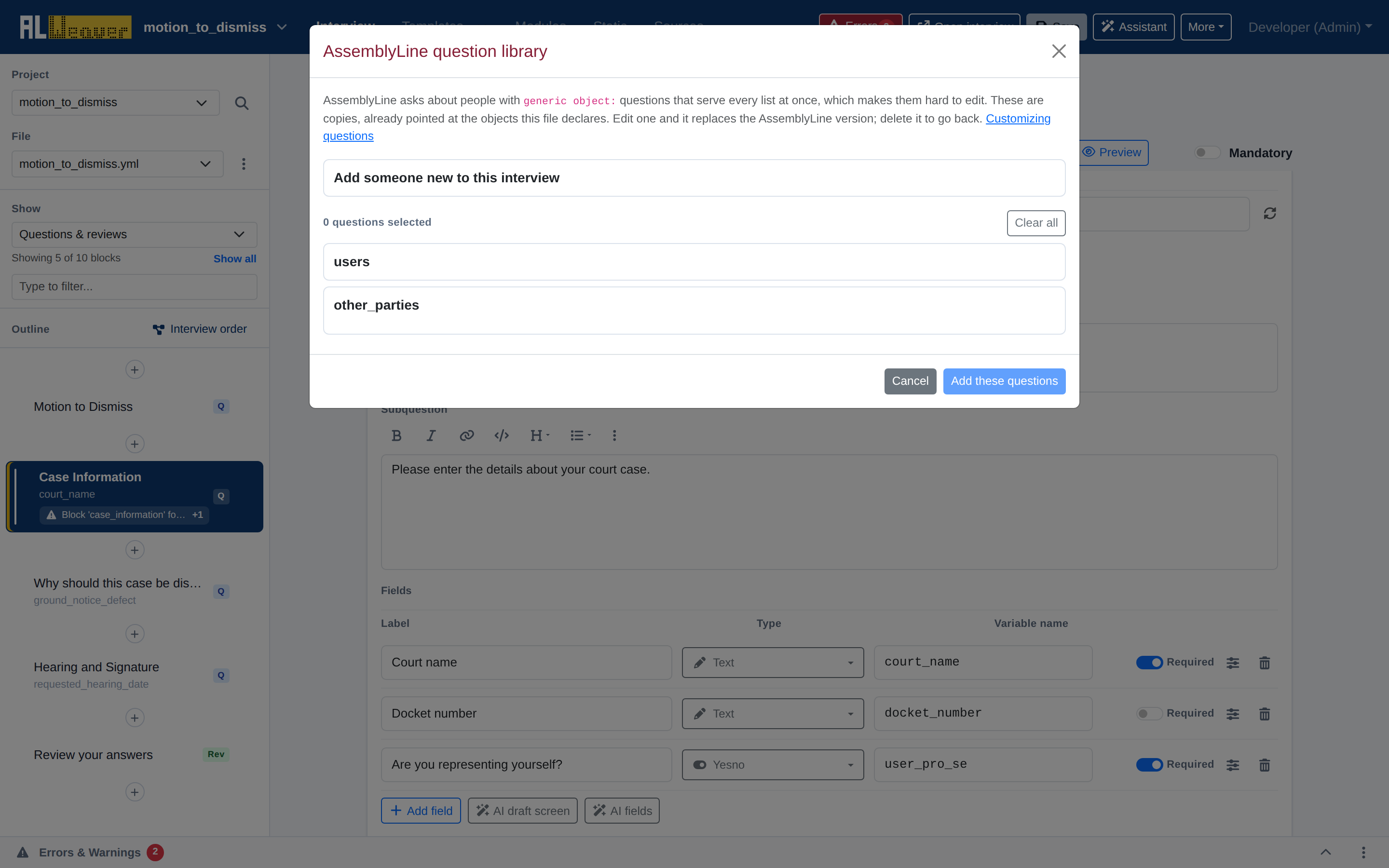
Managing people objects
When you add someone new from the question library, the Weaver declares the list (or single person) in the objects: block and asks you to pick one of four quantity rules, which it writes as keyword arguments to ALPeopleList.using(...):
objects:
  - users: ALPeopleList.using(there_are_any=True)
  - other_parties: ALPeopleList.using()
  - children: ALPeopleList.using(ask_number=True)
Quantity rules
- Ask whether there are any (
there_are_any=True) — the default. Asks a preliminary yes/no question (e.g. "Do you have any children?") before gathering details. - At least one — no extra keyword argument. Skips the "are there any?" question and starts by gathering one.
- Ask how many (
ask_number=True) — asks the user for a number first, then gathers that many. - Exactly this many (
target_number=<N>) — never asks; use this when a form has room for a fixed number of people, such astarget_number=1for a single party.
Pre-built AssemblyLine questions
Click a + quick-add button in the block outline, then choose AssemblyLine question library from the add-a-block menu. For each person object declared in the file, it offers:
- Gather questions: the screens that ask whether there are any, how many, and each person's name (these depend on the quantity rule you picked — see above).
- Attribute questions, one block each: Address, Mailing address, Birthdate, Gender, Pronouns, Language, Phone number, Mobile number, and Email address.
Each entry inserts an editable copy of AssemblyLine's own question wording, already pointed at your object (e.g. children[i].address). Editing the copy overrides AssemblyLine's version; deleting it reverts to AssemblyLine's original. Note that name fields for an existing gather loop come from the name_fields field type described in Question screens and fields, not from this library.
Why use standard question blocks?
Using standard AssemblyLine question blocks ensures:
- Court Consistency: Variable names and data structures match what court e-filing systems and standard court forms expect.
- Plain Language: Prompts have been refined and user-tested for accessibility.
- Translations: AssemblyLine's standard question wording has community-contributed translations into multiple languages, which a copied-in block inherits.
Next steps
- Sequence loops like
users.gather()in the Interview order builder. - Configure your output documents and templates in Document bundles.